
This article has been translated with DeepL.
Radically innovative new companies go partly against the grain when the economy slows down
- Published: 30 Sep 2026,
- 7:11 PM
- Updated: 30 Sep 2026,
- 7:11 PM
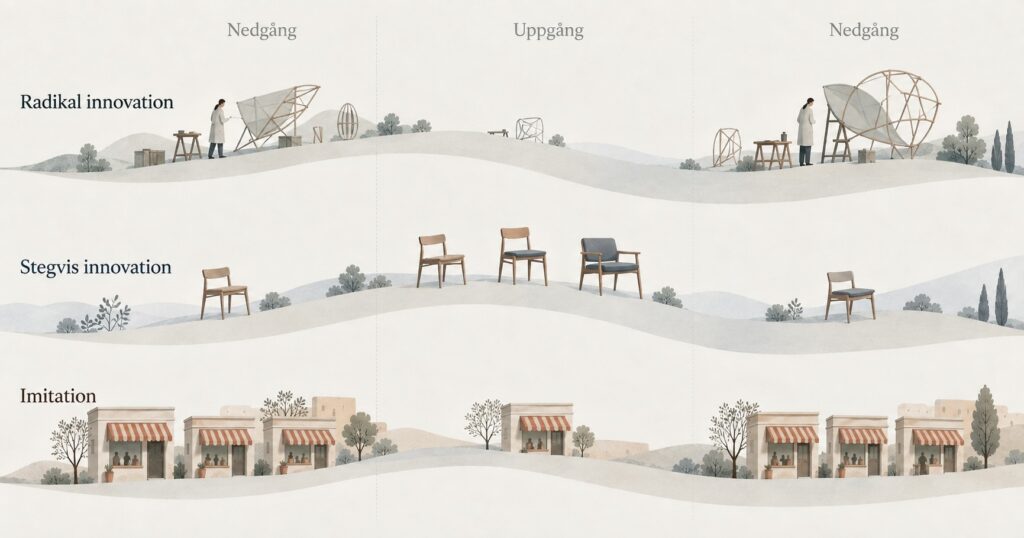
When the economy slows down, established companies often cut back on research, development, and the launch of new products and services. But among startups, the picture is more mixed. An international study suggests that radically innovative and more incremental innovative startups follow different patterns as the economy rises and falls.
Previous research on entrepreneurship has yielded conflicting answers regarding what happens during economic downturns. One explanation may be that very different types of companies are being compared. An entrepreneur who tries to create something customers have never seen before is in a different situation than one who improves an existing product or service, or one who starts a business where the same or similar products or services already exist on the market.
Three types of new businesses — three different patterns
The researchers therefore distinguish between radically innovative, incremental innovative, and imitative new business creation. The analysis is based on data from 66 countries during the period 2003–2018, a period that includes, among other things, the aftermath of the dot-com crash and the global financial crisis.
The pattern emerging from the analyses is that radically innovative and imitative entrepreneurship are more countercyclical than incremental innovation. However, the evidence is not equally strong across all comparisons.
This does not mean that economic downturns automatically lead to more radically innovative firms. The main comparison between radically innovative and incremental entrepreneurship provides only modest statistical support. Nor is the difference between incremental and imitative entrepreneurship statistically significant across the entire dataset. The study shows correlations within the data, not that a recession in itself causes a certain type of business to be started.
A downturn can create new opportunities
The researchers see various possible explanations for the pattern. When the economy is shaken up, established companies can become more vulnerable and old market structures can be disrupted. This can open up space for companies trying to do something radically different.
In better times, the situation is different. Demand is stronger and resources are more abundant, which, according to the researchers, can benefit entrepreneurs who see opportunities to improve and build upon what already exists. For imitation-based firms, the mechanism may be the opposite. When the labor market deteriorates, entrepreneurship can become an alternative for people who find it more difficult to find or keep a job.
These are the researchers’ theoretical explanations. The study does not directly measure why an individual chooses to start one type of business rather than another.
The relationships also vary depending on a country’s level of economic development. Radically innovative new business creation is more countercyclical in less developed economies. For incrementally innovative new business creation, the pattern becomes more procyclical as the level of economic development increases. For imitation firms, the picture is less clear.
It’s about ambition — not the outcome
In the study, the researchers measure innovation based on entrepreneurs’ innovation ambitions, not on how innovative the products or services the companies actually manage to create are. Entrepreneurial activity has been classified based on how novel the entrepreneurs reported their offerings to be for customers and how many competitors are already offering something similar.
The researchers’ main point, therefore, is not that a particular economic cycle is best for entrepreneurship. Rather, the study shows why the question may be misguided from the start. When the economy turns upward or downward, not all new businesses react in the same way. One key difference may be the type of business the entrepreneur is trying to build.
More about the article and the authors:
The article Innovative entrepreneurial entry over the business cycle: variation by form of innovation and country economic development (free to download) is published in the academic journal Small Business Economics.
The authors are Paul Steffens, Adelaide University, Australia, and Kim Klyver, University of Southern Denmark, Denmark.