
This article has been translated with DeepL.
Evidence isn’t enough—that’s why innovations in healthcare get stuck
- Published: 18 Nov 2026,
- 3:49 PM
- Updated: 18 Nov 2026,
- 1:51 PM
Innovative digital solutions may yield good results but still fail to become part of routine care. Clinical evidence alone is not enough when reimbursement models, procurement, and working methods are not effective.
WATCH THE WEBINAR ON ESBRI PLAY
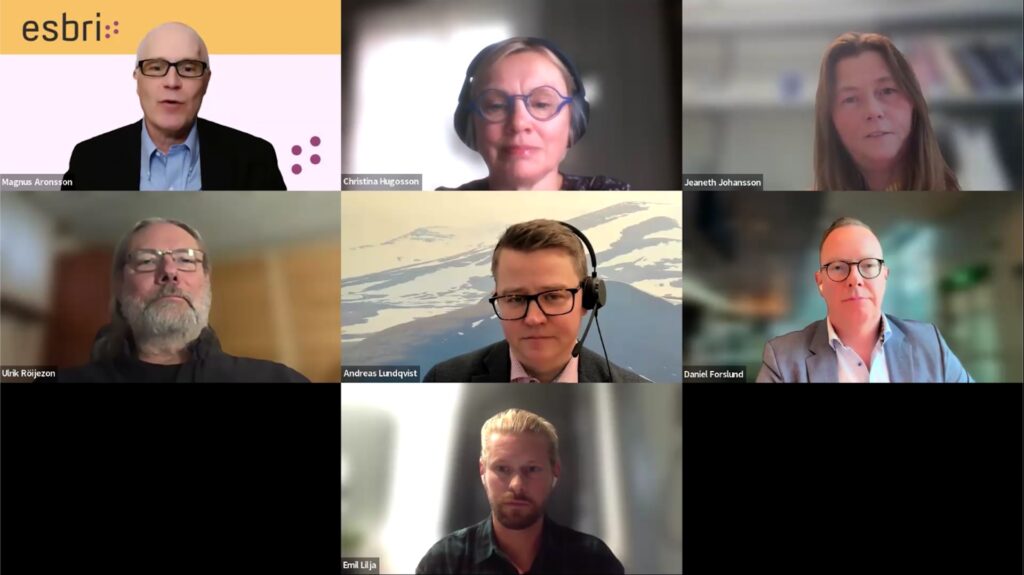
This was discussed during a webinar organized by Esbri and the INNOVAID research project at Luleå University of Technology.
In the project, Professors Jeaneth Johansson and Ulrik Röijezon are investigating what happens when small and medium-sized enterprises try to get innovative digital health solutions adopted in healthcare.
A working solution is just the beginning
Ulrik Röijezon has been working on digital technology that can move measurement and rehabilitation from laboratories to clinics and on to patients’ homes.
“I suppose I was a bit naive in thinking that if we could just show there’s clinical evidence that an innovative digital solution works, then it would automatically start being used. But it turns out it’s not that simple. “The healthcare system may need to change its work practices, staff need time and training, and there must be reimbursement systems in place that make it possible to use the new solution,” noted Ulrik Röijezon.
Ulrik Röijezon likened the path from idea to routine care to a bridge. Need, testing, and clinical evidence are some of the building blocks. But procurement, reimbursement, and the actual implementation must also work. If any part is missing, the bridge comes to an end.
Jeaneth Johansson, who conducts research on entrepreneurship and innovation, sees the same challenge from a business perspective.
“For entrepreneurs, it’s about understanding a complex ecosystem. It’s not just who will use the solution that matters, but also who makes the decisions, who pays, and who actually benefits. These can be completely different stakeholders,” said Jeaneth Johansson.
For smaller companies, this can be difficult to navigate, and Jeaneth Johansson emphasized that they may therefore be forced to combine several business models, seek out private clients, or expand abroad when the public healthcare bureaucracy becomes too cumbersome.
“If companies are forced to find other ways, there is also a risk that the public healthcare system will miss out on innovations that could benefit patients,” said Jeaneth Johansson.
Different Rules in Different Regions
In the panel discussion that followed the researchers’ presentations, Daniel Forslund, Head of Development at Vårdföretagarna, was the first to speak.
According to him, a major challenge for companies is that the regions have different regulatory frameworks.
“A viable solution may face completely different conditions depending on where in Sweden it is to be used. It may be permitted in one region but blocked or subject to different requirements in another, since both local agreements and the interpretation of national regulations can vary,” said Daniel Forslund.
He pointed out how quickly the healthcare system was able to change its practices during the pandemic when the need was urgent.
– During the pandemic, we saw that healthcare workers were able to solve difficult problems quickly when the regions decided to put bureaucracy on hold.
Against this backdrop, Daniel Forslund called for more coordinated implementation processes across regions and greater opportunities for healthcare providers, researchers, and companies to test new solutions together.
Reimbursement systems are slowing down development
Emil Lilja, founder and CEO of Curest, is developing a VR-based rehabilitation program that can also be used in the patient’s home.
“Digitalization isn’t just about adding new technology. We also have to ask ourselves what new ways of working the technology makes possible,” said Emil Lilja.
Curest has worked with patients who live far from a health center, and with the help of Curest’s technology, they have been able to exercise at home with good results. Despite this, a in-person visit was sometimes required for the healthcare provider to receive reimbursement.
“We’ve had patients who live 30 mil from the health center and who’ve been able to exercise at home. But if the work doesn’t count until the patient comes into the clinic, the reimbursement system defeats the very purpose of the solution,” Emil Lilja noted.
When Regulations and Reality Collide
New, innovative digital solutions must also meet patient safety requirements.
Christina Hugosson, founder of EFFIC AB and initiator and coordinator of the “Handbook for More Efficient Development of Medical Devices,” highlighted this challenge.
– Innovations that originate within the healthcare system often have access to patients and understand clinical needs, but can get stuck when they encounter medical device regulations, risk analyses, and standards. Companies, on the other hand, may have the regulatory frameworks in place but struggle to gain entry into the healthcare system and access the clinical environment where the solution needs to be tested. Both sides can thus get stuck—each on their own side,” said Christina Hugosson.
She therefore wants to see a comprehensive approach that includes access to de-identified clinical data, opportunities for companies to test their solutions in clinical settings, and support in navigating the regulatory framework.
“Sweden has tremendous innovative capacity and a strong tradition in medical technology. So we also need to create a pathway that ensures these innovations actually make it all the way to patients,” Christina Hugosson emphasized.
In rural areas, innovation is a necessity
For Andreas Lundqvist, unit director at the Center for Health in Rural Areas in Region Västerbotten, the need for new approaches is particularly evident where distances are great.
“In rural areas, there is often both a greater willingness and a greater ability to work innovatively, for the simple reason that we have to. If healthcare is to reach people who live far from hospitals and health centers, we can’t always work the same way we did before,” said Andreas Lundqvist.
He also highlighted two aspects of public procurement.
– Procurement is necessary to ensure that public funds are used wisely. The problem arises when the processes and lead times become so long that smaller innovative companies can’t stick it out until the end.
According to Andreas Lundqvist, one solution is innovation-based procurement, in which companies and the healthcare sector can develop new solutions together.
– This could make it possible for even smaller entities to participate, but it requires that those responsible for procurement have the knowledge to carry out such processes.
The bridge must be built all the way
Emil Lilja pointed out that these same issues have been discussed for a long time.
– I’m constantly meeting people who say they’ve been working on these issues for 10–15 years. I understand that this is a difficult structural, organizational, and regulatory challenge to overcome. But at some point, we also have to ask ourselves: How many 10–15-year periods are we going to accept before anything actually happens?
At the same time, there are encouraging signs. Jeaneth Johansson notes that there are regions where businesses, research institutions, and healthcare providers are working much more closely together than before. She believes these examples deserve greater attention.
“We need to get better at learning from places where collaboration is already working. We need to create forums where these worlds can actually come together, and this is needed at the national, regional, and local levels,” said Jeaneth Johansson.
For Ulrik Röijezon, the point is that research doesn’t end with a scientific publication.
– The ideas that actually work must also be able to make it all the way across the bridge, with all the building blocks in place, so that they become part of healthcare. The innovations already exist. For them to reach patients, decisions regarding procurement, reimbursement, and changes in work practices must be coordinated. Only then can a solution that works in a pilot become part of routine healthcare, noted Ulrik Röijezon.
WATCH THE WEBINAR ON ESBRI PLAY
Read the interview with Jeaneth Johansson and Ulrik Röijezon
About the
Project The INNOVAID project focuses on small and medium-sized enterprises in northern Sweden. The researchers have conducted 15 interviews and involved four companies, as well as representatives from the healthcare sector and regional innovation support organizations, to understand what facilitates or hinders the adoption of new digital solutions in healthcare.
The project is funded by Norrlandsnavet and PRECISE. Norrlandsnavet at Luleå University of Technology is, in turn, funded by the Kamprad Family Foundation.