
This article has been translated with DeepL.
Porn important for the innovation economy
- Published: 6 May 2011,
- 8:45 AM
- Updated: 6 May 2011,
- 8:50 AM
R&D is often mentioned in the same breath as innovation and innovation policy. And while R&D is very important, innovation is about much more than that. It’s about design, marketing and good supply chains. And about porn – apparently.
On Wednesday, ESBRI, together with the Ministry of Economic Affairs, held a seminar on innovation policy. The seminar was organized in connection with the work on the national innovation strategy and was the first of several in the same area.
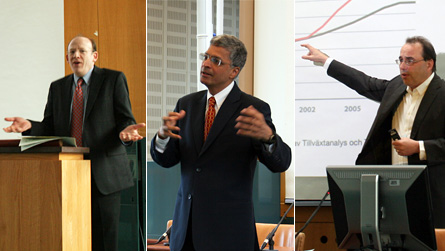
Invited speakers included Amar Bhidé, Professor at Tufts University, Enrico Deiaco, Head of Innovation and Global Hubs at Growth Analysis, and Andrew Wyckoff from the Directorate for Science, Technology and Industry, OECD. Seminar participants came from six different ministries, as well as from government agencies and stakeholder organizations.
The seminar was opened by Catharina Håkansson Boman, State Secretary at the Ministry of Enterprise and Innovation, who welcomed the participants and emphasized the need for a broad and shared understanding of the innovation strategy.
OECD: Innovation is not a silver bullet
Andrew Wyckoff’s presentation was about the OECD’s innovation strategy, and the work to develop it. The project started in 2007, against the background that many countries felt they were lagging behind in innovation. Global competition from emerging economies such as India and China was increasing dramatically. With the financial crisis, the need became even greater.
– At the same time, there are many other global challenges, such as climate, infectious diseases and poverty. Innovation may not be a magic silver bullet, but it can help. That’s why this is high on people’s agenda, said Wyckoff.
Underpinning the work has been a broad approach to innovation, and many different parts of the OECD organization have been involved in the work.
– We have a 10,000 meter perspective. And I think it’s a useful view from up here. Among other things, you can see that there has been some inconsistency between the different OECD departments.
Andrew Wyckoff showed a table of research and development spending in different countries.
– R&D is vital, and it is the main focus of our policy. I didn’t have time to put Sweden in the table, but you know where you are: at the top.
– But it is also important to look beyond R&D. Innovation consists of more components than that.
Wyckoff took the coffee company Nespresso as an example. With smart marketing, strategic partnerships with other companies and a good supply chain, they have achieved incredible growth.
Innovation has always been about combining different disciplines. And while the innovation environment is becoming more global, it is also becoming more open. So how do you support such complex processes?
– It is not an easy question, and there is clearly much to learn and much to do. We see that the role of universities has increased. They attract talent, and act as the glue for new businesses. It is also important to disseminate and share knowledge so that many can capitalize on it. And building platforms for networking between different parties. Like here today, for example.
Sweden under pressure from new competitors
It was then Enrico Deiaco’s turn to take over. He had a similar focus to Andrew Wyckoff, but from a Swedish perspective.
– Sweden is always at the top when it comes to prosperity, so why bother with this? Some even say we are a tiger economy. But we also have many challenges: the labor market does not work very well. Entrepreneurship is not very high. So everyone relies on innovation. But there are many challenges.
As I said, one of the challenges is that we are not alone in investing in innovation. Many countries want to climb the innovation ladder and are investing heavily in this now.
– There are very strong transition pressures ahead, and we have to deal with that. Many of these countries will indeed have a long and difficult journey upwards, but they will climb.
Redrawing the value chains
As a consequence, developing economies are advancing and the US, Japan and the EU are losing out.
– This is not news, but it is important to tell the story. In Sweden, we sometimes have a very national focus. We need to be aware that there is a world out there that is growing rapidly.
This new world requires new ways of looking at how and what creates value, said Deiaco. New value chains are forming, and new types of collaborations where businesses, governments, the venture capital industry and universities are closely linked.
– This makes the policy question much more complicated. Among other things, we need to know how value is created and by whom. What skills do we need to have at home and what can we import?
– Many companies say that policy does not understand the challenges they face. Competition is extreme. So how do we keep multinationals in Sweden?
Mr. Deiaco said that it is no longer possible to distinguish between the service and manufacturing sectors, they are so intertwined. And both are doing well right now in Sweden. He also said that intellectual property issues are becoming increasingly important, that we must have smart legislation and that it is important to attract talent and knowledge.
– It’s really all about productivity. It puts a lot of pressure on us to be innovative. Which also creates major structural challenges, said Deiaco.
Apple as an innovation myth
Amar Bhidé did not use any power point slides in his speech, but he did use some props. These included an iPhone and an iPad.
– These products are clichés, but they are important clichés. Apple spends almost nothing on R&D. But they spend a lot on marketing and design. It really shows the breadth of today’s innovative climate.
– Apple also has a great supply chain. And many other companies have a big part in their success. Like the nonsense game Angry Birds, for example. The porn industry has also played a huge role in the development of the modern ICT industry, said Amar Bhidé.
He called the iPad an “unnecessary product”. It’s Apple’s great marketing that makes us think we need one. Another part is that we are what Bhidé calls “venturesome consumers”. We are willing to spend money on uncertain products.
Amar Bhidé said there is too much talk about high technology and innovative products.
– It’s all about productivity. Then whether it’s a new cool cell phone, an Angry Birds or a new café doesn’t really matter. What matters is how much of the population of a country is involved in that kind of production.
– Everyone knows this, but still has a very elitist view of innovation when it really matters. They think it’s all about new high tech. And sure, Silicon Valley is great, but California as a whole is doing really badly. We have to look at the economy as a whole.
Risk-taking consumers drive the market
Many countries are concerned that not enough engineers are being trained, or that students are not performing well in maths competitions. But the modern economy requires a much broader skill set than that, for example in design and marketing.
– So should we focus on teaching children to be the best at algebra or perhaps a little more on developing their communication skills?
The financial system was given a pretty good dressing down by Bhidé, especially the US one. He argued that the US has a good innovation climate despite the financial system, not because of it. The financial system is most important when it comes to consumer credit. Most people who buy an iPhone don’t have enough money of their own, but rely on some form of financing to make the purchase.
– This is absolutely crucial for the risk-taking economy, as I call it. But there has to be a balance: if you give too much credit and people can’t pay, there is a risk of the system crashing.
So, what is needed in terms of policy to promote the innovation economy, according to Amar Bhidé?
– At the risk of being controversial, I am skeptical that a national innovation strategy is needed at all. I’m much more inclined to think that a broad sensitivity to innovation and how to promote it is important.