
This article has been translated with DeepL.
Economic financing in transition
- Published: 11 Oct 2010,
- 8:45 AM
- Updated: 11 Oct 2010,
- 9:07 AM
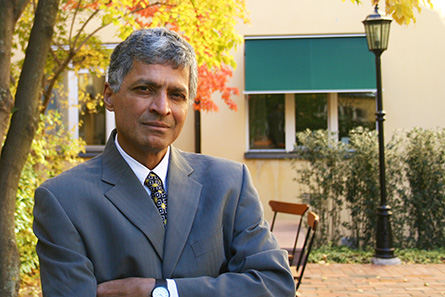
Professor Amar Bhidé from Tufts University, USA, gave an Estrad lecture on November 10, 2010 entitled “Financing the Venturesome Economy”. Bhidé believes that those interested in entrepreneurship should also be interested in our financial system. When the financial system collapses as it has done, it hurts not only financiers but the whole society. No one is spared.
– We have left the design of the economic system to financial experts, and we continue to let them deal with the problems – even though they caused the problems in the first place. It is time for all of us to take responsibility for this,” said Amar Bhidé.
He acknowledges that his approach is thoroughly American, but he believes it can be important for outsiders to understand the errors that have occurred in the United States.
– There are two major misunderstandings about the economic collapse. One is that the capitalist system is fundamentally flawed and should be changed from the roots up. The second misunderstanding arose from an overly narrow view of the crisis: it is claimed that the financial system is actually working quite well, and that therefore all we need to do is update the controls of the system.
But Bhidé argues that both these claims are wrong. He thinks that the real economy, as opposed to the more abstract financial economy, works quite well. This is because today we have an inclusive, innovation-driven economic system that contributes to our high standard of living.
– At the same time, the financial system has serious flaws. It undermines the real economy, it is unstable and the rules are misaligned. The flaws in the system can be traced back 20 years. They have been woven into our textbooks and become apparent when new ideas are implemented.
The real economy is tied to real accountability. The modern financial system, on the other hand, has become centralized and characterized by mechanical models where judgment and dialogue have disappeared. There is almost no correlation between the right to make decisions and the responsibility for poor performance, says Bhidé.
Some people see innovation as if it were the Olympic Games. Only the most successful get a place and the rest of us just enjoy their hard work. Amar Bhidé thinks this is wrong. More players are needed.
– Broad-based prosperity requires broad-based productivity. Unless everyone’s productivity increases, there can be no increase in per capita income. This means that we need not only to develop innovations, but also to spread their use. The benefits from that benefit us all. To sell new technologies, we need new ways to sell, market and take risks.
– We need diverse people in this game. In the future, we need to consider what kind of education policy we should have, and to what extent we should subsidize R&D. Those decisions also affect what kind of financial system we should have. A financial system designed for today’s dynamic society has to be quite different from one designed for a society where not much changed.
The financial system should reflect and feed a dynamic, real economy. It is up to the financier to make an assessment of whether the investment in a loan or product will be profitable. Such assessments are easier to make if there is an ongoing relationship between the financier and, for example, the small business owner applying for a loan.
– Parts of our economy still work this way. The venture capital industry, which funds the most cutting-edge technology in the world, still works in this old-fashioned way. For business angels, relationships are also important.
But it is not in the benign economy that the growth of the financial sector has been found. Instead, it is in the centralized part, where dialogue and relationships have disappeared, says Bihdé. “The banking systems have become so large that it is impossible to find anyone responsible.
– Over the last 30 years, the trend has been for even small loans to need collateral. This applies not only to railways and dams, but also to loans on houses, cars and simple credit card loans.
Bhidé believes that the whole idea of assessing loans on a case-by-case basis is gone. People don’t even really need to be involved in the process. Today, you can take out a loan quickly via the web.
– This mechanization of borrowing has led to the birth of a few mega-companies.
– When it takes time and effort to verify the funding of each loan, banks are not as big. When banks did this manually, they had much more control. Now, big banks can say they didn’t know the risks – and they’re right.
Looking at this from the entrepreneur’s point of view, there is a serious downside to the almost mechanical centralization, says Bhidé.
– First of all, one has to assume that capital will be misallocated. When banks stop doing case studies, they will simply make worse decisions. It also leads to the neglect of real entrepreneurship.
– Today, we do not know what would have happened if we had not created this mechanical way of managing finance, or how much more capital we would have had available for entrepreneurship. I suspect it is not an insignificant amount.
The current system also generates instability, says Bihdé. “When all models are created from one or two very similar mathematical models, they are not very innovative. If there is something wrong with them, whole systems can crash, which spills over into society and results in people not being able to pay their bills. If you start digging, you realize that all capital comes from the same source.
– We need to evaluate risks in their context. If we think of the economic system in multiple dimensions, it cannot be reduced to a single mathematical model. That is, you cannot quantify risk-taking and turn it into a computer program. Computer programs do not take into account different opinions, dynamics or multifaceted, unquantifiable uncertainty.
As the economy becomes more technologically advanced, the need for rules becomes greater and greater. Bhidé cites the example of today’s hectic and demanding car traffic, where many different traffic rules are needed to make everything work. Of course, the amount of regulation needed in different areas depends on how dangerous it becomes in society when someone misbehaves. The nature of banking activities is such that they would not work without precise and narrow rules.
– “Much of this can’t be helped, the financial system has evolved in recent years and will not ‘go away’,” said Bhidé.
Nevertheless, he believes that we could improve economic regulation, or at least make some progress. One attempt is a new 230-page law created in the US to regulate the economy. But a top-down approach to economic issues does not work, says Bhidé.
– I offer the following retro-radical suggestion: we should review economic cases much like a judge and jury review a court case. It can’t be done in exactly all cases, but in many. Banks should focus primarily on the sound deposit of money and a sound payment system. When this did not work, the economy was almost destroyed in 2008.
“Historically, if we ensure safe deposit and payment systems for our money, we also ensure a sensible increase in credit,” says Bhidé. For example, in the 1950s and 60s, when banks were quite controlled in the US, total credit grew by 8-9% per year.
– We should also use what I call a ‘prudent borrowing rule’, where you always ask yourself: is this the kind of loan I would have taken if it was my own money?
– This means closing down shadow banks and parallel banking systems, which are practically parasitic on the system. Perhaps the time has come to reinstate full state control over money?
– Finally, we need to focus on what is not working. There is a deep-rooted pathological centralization of the financial system that needs to be addressed. Simply stabilizing what happened in 2003-2004 is not the solution. At the same time, we need to protect and nurture what is happening in the real economy, which is the ultimate source of prosperity.
The lecture was based on Amar Bhidé’s books “The Venturesome Economy” and “A Call for Judgment”.