
This article has been translated with DeepL.
Hallo there, Vinit Parida – top Swedish scientist on global list
- Published: 11 May 2026,
- 11:28 AM
- Updated: 11 May 2026,
- 11:31 AM
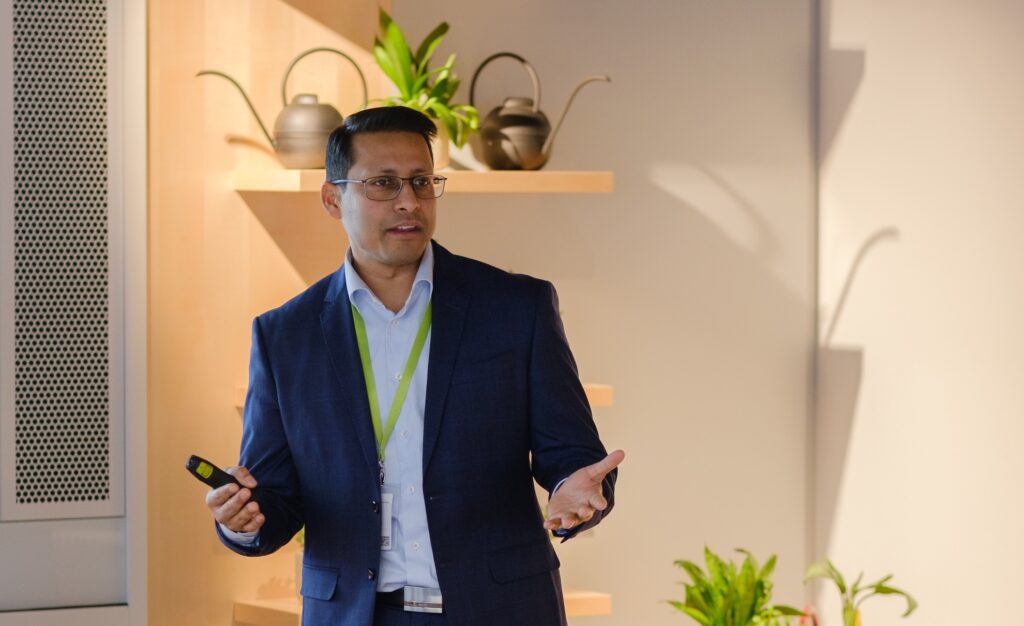
Entrepreneurship and innovation researchers dominate the Swedish part of a global ranking of top researchers in business administration. In second place and first in Sweden among entrepreneurship researchers is Vinit Parida, professor at Luleå University of Technology.
Congratulations on your top spot in the Research.com rankings. How does it feel?
– Thank you very much! It’s nice to be noticed and recognized alongside other researchers who are pushing our field forward. At the same time, I think we should be careful not to make too big a deal out of lists like this. There are many researchers who are doing important and useful research, but who are not captured by the criteria used by Research.com, for example.
Of the 38 researchers on the Swedish list, just over half are researchers with a primary focus on entrepreneurship and innovation. What do you think about that?
– I think it shows that Sweden has developed into one of the leading environments internationally in entrepreneurship and innovation research. Three decades ago, there were a handful of researchers at a small number of universities. Today, there are relatively large research groups at many universities.
– We can also see that the innovation component has become stronger over time, and that interesting research is being done at the interface between innovation and entrepreneurship research, for example on business model innovation.
Speaking of business model innovation – that’s something you’ve been researching yourself with colleagues.
– That’s why I mentioned it (laughter).
– Joking aside, it is important to understand more about business model innovation, not least in a time of rapid change. We work closely with many large Swedish manufacturing companies in this research. They develop new technology, but struggle with how to commercialize it in a profitable way.
– This is where our research comes in by helping to identify the capabilities that businesses need to develop. This may involve rethinking partnerships with other actors and finding new ways to create value together with customers.
A quick look at the titles of your publications gives the impression that you research both small and large companies, entrepreneurship and innovation. Is that correct?
– Yes, my research profile is broad. For me, it is important to conduct research that is meaningful. This often means that the empirical phenomenon or context is allowed to govern. It can be something that is important for society at large, for an industry or for an individual company. This curiosity has led me to get involved in many different research projects.
– In addition, I have had the privilege of collaborating with both well-established researchers and younger, ambitious researchers to try to understand the empirical contexts we study. It is about exploring what is happening, why it is happening, what could be done better and what lessons can be learned. Lessons that others can also benefit from.
What research are you currently working on?
– I am involved in projects of a very different nature. One project is about AI, where we are studying how companies are working to integrate AI to make their operations more efficient. But perhaps even more important is the question of how AI can be used in companies’ innovation work.
– In another project, we are studying how waste can be transformed into something of value. One example is religious waste in India, in the form of flowers sacrificed to the gods, and how it is being utilized by entrepreneurial companies. Another example is in Sweden, where startups are working to take care of waste from various process industries.
What do you hope your research will contribute to in the future?
– I hope it can help businesses and society better manage major transitions. Ranking lists can be nice, but at the end of the day, the most important thing is that research is useful – for businesses, for people and for society.
Contact vinit.parida@ltu.se
More about Vinit Parida
Professor and Head of the research subject Entrepreneurship and Innovation at Luleå University of Technology (LTU). As a 26-year-old, he defended his thesis at LTU in 2010 with the thesis Achieving Competitiveness through Externally Oriented Capabilities – An Empirical Study of Technology-Based Small Firm.
He is also responsible for research in Norrlandsnavet, which is a collaboration between the Kamprad Family Foundation and Luleå University of Technology.
Read a portrait of Vinit Parida
The list of entrepreneurship and innovation researchers
The list comes from “Research.com Best Business and Management Scientists in Sweden”. You can find the full list here.
The number in brackets is the ranking among Swedish researchers.
| Name | Institution |
| Vinit Parida (2) | Luleå University of Technology |
| Per Davidsson (4) | Jönköping University |
| Magnus Henrekson (6) | Institute for Business Research |
| Roberto Verganti (7) | Stockholm School of Economics |
| Karl Wennberg (12) | Stockholm School of Economics |
| Mattias Nordqvist (14) | Stockholm School of Economics |
| Christian Kowalski (15) | Linköping University |
| Lars Witell (16) | Karlstad University |
| Sarah Jack (17) | Affiliated with the Stockholm School of Economics |
| Magnus Klofsten (19) | Linköping University |
| David Rönnberg Sjödin (20) | Luleå University of Technology |
| Charlie Karlsson (21) | Jönköping University |
| Pejvak Oghazi (24) | Södertörn University |
| Johan Frishammar (25) | Luleå University of Technology |
| Hans Landström (27) | Lund University |
| Maureen McKelvey (28) | University of Gothenburg |
| Sylvie Chetty (29) | Affiliated with Uppsala University |
| Leif Melin (33) | Jönköping University |
| Mats Magnusson (34) | KTH |
| Svante Andersson (37) | Halmstad University |