
When women own more, companies’ priorities look different

It is not enough to know whether women are among the owners. The share of the company they own also appears to be significant. A study of companies in France, Italy, and Spain links women’s ownership share to growth, liquidity, and how companies describe their value creation.
Hello there, Jeaneth Johansson and Ulrik Röijezon—why aren’t digital innovations making their way all the way into healthcare?

Digital solutions are being developed, tested, and showing promising results. Yet many of them never make it into routine clinical care. Why does the journey end after the pilot project? Professors Jeaneth Johansson and Ulrik Röijezon at Luleå University of Technology are investigating the barriers between innovation and actual use.
Entrepreneurs challenge those in power—until they themselves become powerful

Entrepreneurship can spread economic power and give more people the opportunity to influence decision-making, thereby strengthening democracy. But over time, successful challengers may themselves begin to protect their power. Entrepreneurship policy needs to take this paradox more seriously, according to Professor David Audretsch.
The entrepreneur who gave Scotland’s space industry a boost

When Craig Clark founded Clyde Space in Glasgow in 2005, he saw a business opportunity in small satellites. A new study shows how his initiative also helped bring together companies, universities, and public sector organizations to develop a burgeoning Scottish space industry.
Radically innovative new companies go partly against the grain when the economy slows down
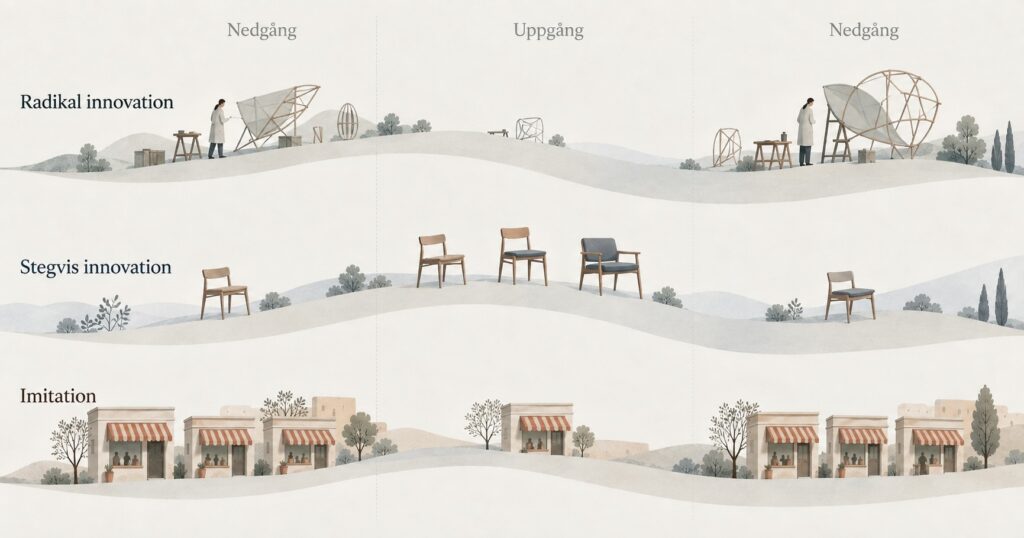
When the economy slows down, established companies often cut back on research, development, and the launch of new products and services. But among startups, the picture is more mixed. An international study suggests that radically innovative and more incremental innovative startups follow different patterns as the economy rises and falls.
BOOK TIP | How does an entrepreneur navigate uncertainty?

Seeing an opportunity is not the same as knowing whether it’s worth pursuing. An entrepreneur must also determine when it’s time to enter the market, change course, grow, or shut down. Such decisions are often made with incomplete information. These are the types of decisions at the heart of the book The Entrepreneurial Compass by Dean A. Shepherd and Holger Patzelt.
Startups led by women are more likely to advance—but less likely to go all the way

In an American pitch competition, startups led by women had an edge in the initial selection round. In the finals, the trend reversed. This is shown by a new study published in the top-ranked academic journal *Administrative Science Quarterly*.
Critical organizations can lend greater credibility to innovations

Organizations that scrutinize and criticize companies can also become valuable partners when bringing new products and services to market. A study of German companies shows that such partnerships are associated with higher sales for companies that have previously faced media criticism and in industries where levels of corporate responsibility vary widely. However, the researchers did not find any general sales advantage.
The legacy of the Gold Rush is still evident in entrepreneurship today

The Gold Rush in 19th-century America drew hundreds of thousands of people westward in hopes of finding gold. But it may also have left a much more lasting impact. A new study shows that areas shaped by the Gold Rush have generally had higher levels of entrepreneurship than comparable areas for more than a century.
Hello there, David Audretsch—what does entrepreneurship have to do with democracy?

What role can entrepreneurship play for democracy? That question has become increasingly important to Professor David Audretsch at Indiana University. Ahead of Esbris’ webinar , Entrepreneurship Beyond Technology: Power, Institutions, and Democracy, we asked him why power, institutions, and democracy have become increasingly important in his research.