
This article has been translated with DeepL.
Future innovators are inspired by nature
- Published: 29 Apr 2026,
- 11:39 AM
- Updated: 29 Apr 2026,
- 2:29 PM
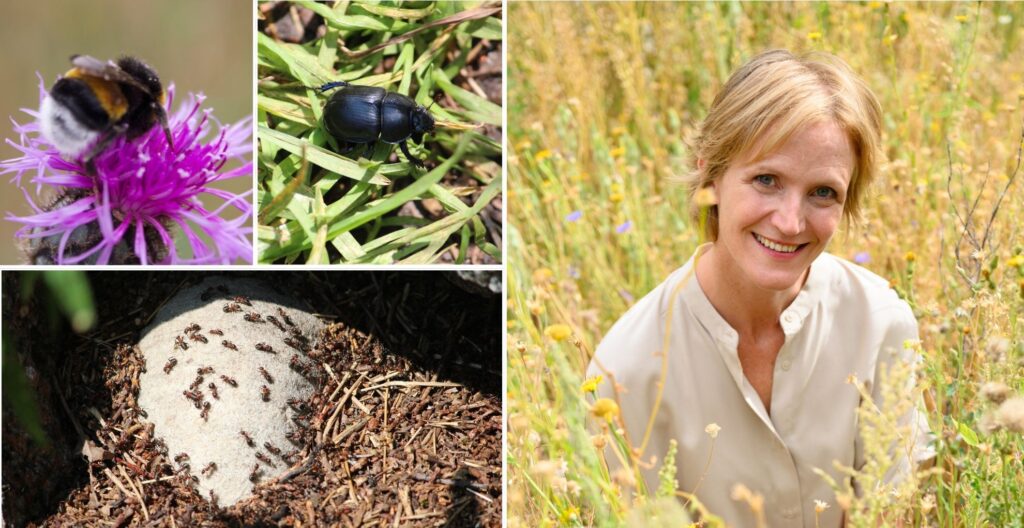
The ability to observe, identify and understand nature is a source of innovation. According to Professor Seirian Sumner at University College London, fostering the innovators of the future requires children to become more knowledgeable about nature.
Now that spring is here and nature is awakening, there are opportunities to use nature as a gateway to creativity, the joy of discovery and innovative thinking. The ability to notice details, discern patterns and understand connections in nature is also linked to innovation and entrepreneurship – namely, spotting opportunities and trying out new solutions.
For Seirian Sumner, a professor of behavioural ecology, nature literacy is more than just knowledge of species.
– It’s about being able to spot differences, recognise patterns and put into words what you discover. “Those who can read nature gain more ways of understanding problems and more paths to solutions. When we learn to see what distinguishes one plant from another, how an animal moves, or how a pattern recurs in an ecological system, it also opens up more avenues to questions, connections and ideas, says Seirian Sumner.
It starts with attention and time
Being attentive is important. It’s about pausing, taking a second look and asking yourself: What is that? Why does it look like that? How does it work?
– The closer you look at nature, the more you see, and the ordinary becomes extraordinary when you look closely. Through curiosity and by taking the time, something new can emerge.
Seirian Sumner believes this gives rise to ideas that can be translated into technology, architecture, materials or the way we organise society. But this requires us not simply to note something unexpected and move on.
– Today, we are often so busy that we don’t stop when we see something strange. We note that it looks strange – and move on. But many ideas arise precisely in that pause, because we don’t let go of what has caught our attention but stay and reflect.
Inspiration from nature
History is full of inventions that have drawn inspiration from nature. A classic example is how burrs gave rise to Velcro. Other examples can be found in architecture, where termites have inspired energy-efficient buildings, and in technology, where ant trails have been used as a model for algorithms that optimise delivery routes.
– But nature’s significance does not stop there. Nature has also inspired art, design, medicine and many other fields over the centuries. When people look closely at the natural world, ideas emerge that can be applied in entirely different contexts.
This is an ability that Sumner believes has weakened in modern society. In the past, we lived in closer contact with nature and were more dependent on being able to interpret it. That is why both parents and teachers need to help children become more nature-literate.
– Where will new innovations come from if we have lost both the desire and the ability to notice, name and understand nature?
More nature literacy in schools
One way to increase science literacy is to give it a bigger place in schools. Not only in biology, but also in other subjects. Science can be included in history, geography, mathematics and many other subjects.
– Nature is not a sideline, but something that can inspire teaching in many different parts of the school. Close reading of nature gives rise to new ideas, and reconnecting with nature also increases the possibility of creating more innovations. A school that wants to promote creativity, innovation and entrepreneurship therefore cannot just talk about it in the abstract. It must also teach children to see and discover, says Seirian Sumner.
So why is this not done more? According to her, the problem is not the children’s lack of interest, but the adults’ insecurity. Many teachers and parents feel that they themselves lack knowledge of nature.
Technology can lower the threshold
Today, neither parents nor teachers need to know everything in advance because there is technology, such as apps, that can help. These make it easier to identify plants, birds, insects and animals.
– Various digital tools can help lower the barrier to engaging with nature. Adults can be curious alongside the children and make discovery part of the learning process.
Sustainability and nature literacy
If nature is to become part of the solutions of the future, an understanding of nature must also become part of the skills of the future. A business sector that wishes to work with nature-based solutions must understand what it is talking about. Otherwise, there is a risk of a gap emerging between strategy and reality.
– That gap becomes particularly clear in innovation-intensive environments, where many organisations today are seeking solutions that are both scalable and sustainable. Sustainability without an understanding of nature then risks becoming exactly what the term is often accused of being: pretty but shallow.
– Without an understanding of nature, it also becomes harder to understand why nature is worth caring about. And thus also harder to build a more sustainable society, concludes Seiran Sumner.
Fact box: This is natural literacy
Nature literacy in this article is about more than just species knowledge. It concerns the ability to observe, name, understand and discuss nature.
This ability encompasses four areas that are also central to entrepreneurship and innovation:
Attention – noticing details, anomalies and patterns.
Language – being able to describe what one sees and share knowledge with others.
Systemic understanding – understanding relationships, flows and functions in complex environments.
Problem-solving – learning from effective solutions in nature and translating them into human contexts.