
This article has been translated with DeepL.
AI startups – new model helps investors and customers
- Published: 25 Mar 2026,
- 11:16 AM
- Updated: 25 Mar 2026,
- 2:32 PM
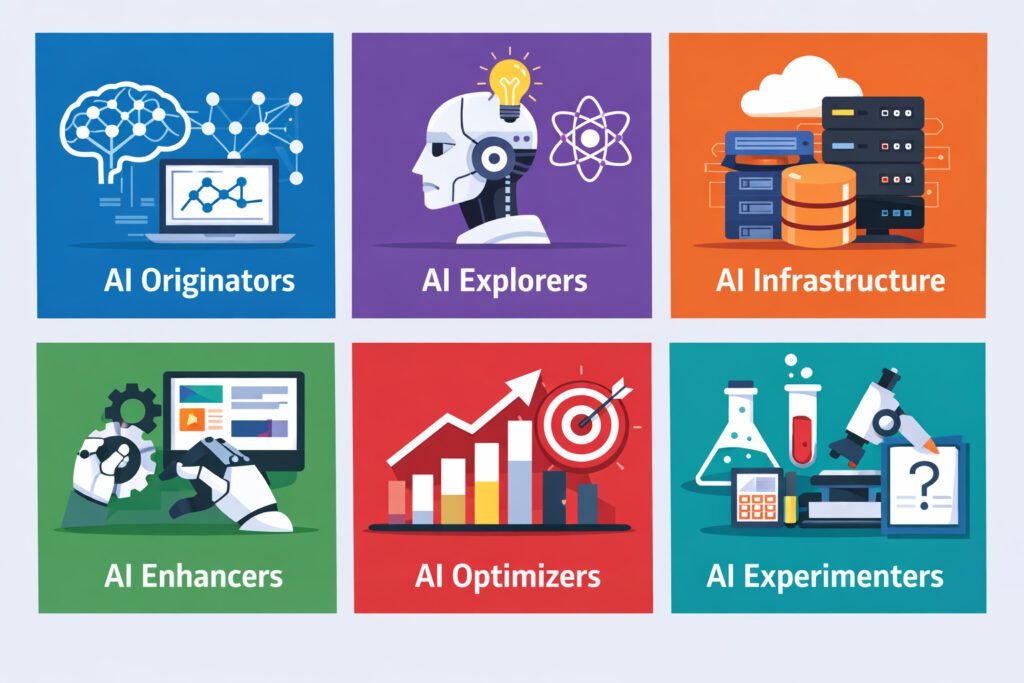
Venture capital is flowing to AI companies and customer interest is high. But behind the boom are major differences in how the companies create value. Now, two professors present a typology of six different AI startups.
Generative AI is being used by more and more people and is becoming increasingly important to both investors and customers. In a recent article in the MIT Sloan Management Review, Babson College professors Jeffrey P. Shay and Thomas H. Davenport argue that AI startups should not be considered a single group.
They argue that the current boom in AI start-ups is driven by venture capital, strong customer interest and significant opportunities to transform products, processes and business models. But as AI is used in many different ways, investors, customers and even the startups themselves need to understand how an AI startup creates value.
Therefore, they have created a typology of how AI startups create, deliver and extract value: creators, explorers, infrastructure builders, improvers, optimizers and experimenters.
Six categories of AI startups
AI originators build the basic models themselves. Companies in this category develop generative AI systems for broad applications and operate at the cutting edge of AI development. The barriers to entry are high, but so is the potential financial upside.
AI explorers focus on inventing the AI of tomorrow. They work in areas such as agent-based AI, quantum AI and artificial general intelligence (AGI). Their progress is often judged by published research and research project milestones rather than short-term revenues.
AI infrastructure builders provide the technical tools that enable others to develop and implement AI. Their work covers areas such as data labeling, vector databases, experiment tracking, and machine learning platforms. Their success will be based on their integration into workflows and impact on the ecosystem.
AI enhancers use AI models for broad use cases to solve specific industry or function-related problems. This includes startups focused on content generation, editing various media, and agent-based AI tools for narrower business processes. The researchers note that this is where much of the startup activity is concentrated, but that lasting differentiation depends on proprietary data, domain knowledge and user experience.
AI optimizers do not develop or sell AI directly. Instead, they use the technology internally to improve their own operations. In these companies, AI acts as an operational lever to improve decisions, lower costs and accelerate product cycles.
AI experimenters are testing AI tools, but have not yet made AI a central part of their strategic development. According to the researchers, many organizations are at this stage, and their biggest challenge is to translate experimentation into increased business value at scale.
Changing categories
The six categories are not exclusive or permanent, according to the researchers. A startup can start as an experimenter, become an optimizer and later evolve into an enhancer, but these transitions require capital, expertise and strategic focus.
More about the article and the authors
The article Six Types of AI Startups, Explained is published in the journal MIT Sloan Management Review.
The authors are Professor Jeffrey P. Shay and Professor Thomas H. Davenport, at Babson College, USA.